


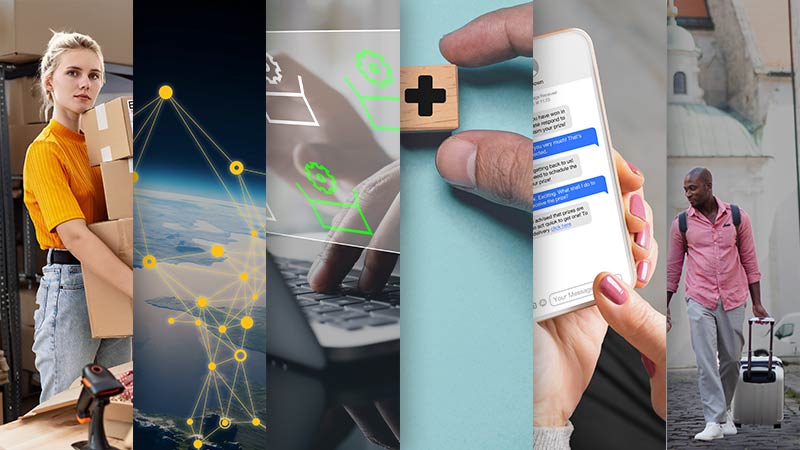
Leisure travel making a comeback and the ascent of AI are among the six payment trends to observe in 2024.
The payments industry is characterized by perpetual change, and 2024 is poised to introduce its own set of transformations. Broadly speaking, we anticipate a reversal of established norms from previous years: businesses that were once strictly local will expand on a global scale, closed-loop and proprietary technology will become more open, generic solutions will evolve into more customized offerings, and networks that were once isolated will become increasingly interoperable. The influential impact of AI and the resurgence of consumer travel further contribute to the dynamics shaping the landscape of payments in 2024.
1. Creators, SMBs go global
In 2024, the globalization trend is reaching small and medium-sized businesses (SMBs), encompassing creators, sharing economies, e-commerce, and traditional brick-and-mortar establishments. Businesses of all sizes are shifting their mindset from local neighborhoods to the broader global digital economy.
A substantial 79% of SMBs now prioritize selling across borders for growth, reflecting a changing consumer landscape where 72% of consumers express comfort in purchasing from businesses in other countries.
Digital payments are playing a transformative role, empowering SMBs to pay and receive payments efficiently. This shift enables businesses to tap into new audiences, securely accept payments, monitor spending, enhance security measures, and foster growth. Innovations in payment solutions, such as real-time access to earnings and virtual cards, contribute to the convenience of receiving consumer and B2B payments, facilitating a smoother payment process for SMBs.
As we move forward into 2024, the increasing digitization of payments is expected to benefit small and micro businesses, accelerating and securing transactions, and making global expansion more accessible than ever before.
2. Interoperability gains steam
The convenience and speed of digital payments have revolutionized money transactions, both within a country and across borders. However, the proliferation of networks and payment methods, ranging from money-moving apps and wallets to blockchains and legacy infrastructure, has resulted in a fragmented and disjointed user experience. Each solution often operates within its isolated ecosystem.
Fortunately, this scenario is starting to evolve. With a growing emphasis on interoperability among payments players, a more seamless future for global money movement is on the horizon. This future envisions a landscape where paying across services is as effortless as using any single service, breaking down barriers and delivering numerous benefits to end users, financial institutions (FIs), corporate clients, fintech enablers, and app providers.
In 2024, we anticipate continued collaboration across the payments ecosystem, involving banks, FIs, merchants, technology providers/enablers, and issuers. This collaborative effort aims to enhance global financial inclusion, accessibility, cross-system compatibility, and overall interoperability. We can expect the development of more technologies to assist both consumers and businesses in navigating the intricacies and complexities of cross-border money movement.
3. Open infrastructure solves hard payments problems, making commerce easier
In the current consumer landscape, if a tech solution doesn’t align with our preferences, we tend to seek alternatives that offer better, easier, and more suitable options. Payments, as a crucial part of this technological shift, are not exempt from these evolving expectations.
In 2024, a significant transition is anticipated towards more modular and platform-agnostic infrastructure in payments technology. This shift enables businesses to seamlessly integrate the kind of experiences that consumers have come to expect.
In practical terms, this shift allows businesses to adopt and utilize products and services based on their specific needs. For instance, if a business lacks a robust token solution, they can seamlessly add one to their existing tech stack. Need to enhance the omnichannel experience? This can be implemented without disrupting the entire payments gateway. The adoption of network-agnostic payments services facilitates plug-and-play solutions for addressing complex problems.
The expectation is that not only will more payments companies overhaul their infrastructure with these open tools, but an increasing number of businesses will reap the benefits of these new layers and capabilities. Consequently, the world of commerce is poised to become more straightforward to operate.
4. Consumers expect tailored solutions. For merchants, banks and FIs, services make them possible
Consumer expectations extend beyond shaping payments infrastructure; they increasingly demand personalized experiences. Whether you are a merchant or a bank, meeting these expectations quickly often requires significant tech and engineering resources, potentially introducing more complexity than organizations are willing to handle. Consequently, more businesses are turning to partner-based solutions or managed services to bridge this gap.
Value-added services developed through strategic partnerships offer companies the ability to meet consumer expectations without disrupting their core operations or undertaking the development of new capabilities in-house, which can be both costly and time-consuming, with no guaranteed success.
As the reliance on digital payments grows, the urgency surrounding these decisions intensifies. The choices made by merchants, banks, and financial institutions today will likely have a lasting impact on their business in the years to come. These improvements not only unlock the full potential and efficiency of a business but also play a crucial role in building trust with customers and facilitating agility during times of rapid change.
5. AI brings new opportunities — and challenges — to payments
A little over a year since Large Language Models (LLMs) emerged, one of the most promising future applications of generative AI lies in the realm of fraud prevention. Specifically, it presents an opportunity to analyze and learn from an unprecedented volume of data, surpassing what traditional predictive models can achieve. The next generation of AI holds the potential to draw insights from diverse domains, assisting in the training of fraud detection tools to make more informed and accurate decisions, distinguishing between fraudulent transactions and legitimate purchases.
Generative AI is set to revolutionize various aspects of our work, enhancing products, data structures, models, operations, and infrastructure. At Visa, we’ve observed a significant improvement in coding productivity, with a 30% increase, as Generative AI tools effectively handle time-consuming and repetitive tasks (such as boilerplate code generation). This allows engineers to focus on producing high-value code, resulting in products that differentiate themselves in the market.
However, the rise of AI also introduces new challenges to the payments landscape. Generative AI tools can aid fraudsters in creating more realistic phishing scams, making it increasingly difficult for consumers to identify characteristic spelling and grammar errors. This evolving threat landscape sets a higher bar for businesses and consumers, necessitating adaptability to stay ahead of emerging risks.
6. Travel returns with a vengeance
With the worst of the pandemic behind us, the travel industry is experiencing a resurgence, and this momentum is expected to continue in the coming months. The driving force behind this spike is a collective yearning for relaxation and stress-free holidays, seeking a reprieve from the inconveniences imposed by the COVID era.
Visa’s Global Travel Intentions Study 2023 reveals that, despite awareness of the rising cost of vacations (cited by over 70% of travelers), the majority remain undeterred, with only 4% planning to cut back on their travel plans. Globally, travelers are eagerly anticipating an average of 2 leisure trips over the next 12 months, with affluent travelers looking forward to even more.
While the desire for travel is strong, certain pandemic-era preferences persist. Flexibility in travel arrangements remains a priority, and safety and cleanliness considerations are significant factors influencing accommodation choices.
In addition to smaller ticket items, travelers are increasingly opting for safe, digital, and touch-free payment experiences. Despite awareness of sustainable travel and tourism, research by Visa and Oxford Economics indicates that 41% of travelers feel they lack information about sustainable travel options, and 36% find the available information not credible. Initiatives like Visa’s partnership with Ecolytiq, providing estimated carbon emissions based on transactions, and Travalyst, a global sustainable travel initiative offering consumers consistent and visible sustainability information, particularly in accommodations and aviation, aim to bridge this information gap.
Change can be good
Ultimately, change can be a positive force, especially when it leads to improved outcomes for consumers, businesses, communities, and economies. Embracing change means envisioning a world where small businesses can thrive in a global marketplace, where open infrastructure and managed services provide banks, financial institutions, businesses, and consumers with the solutions they need. In this future, moving value across networks is as easy, seamless, and secure as moving it across a single network. The prospect of such advancements makes the anticipation of 2024 all the more exciting.